How to Check Yourself for Diastasis Recti at Home
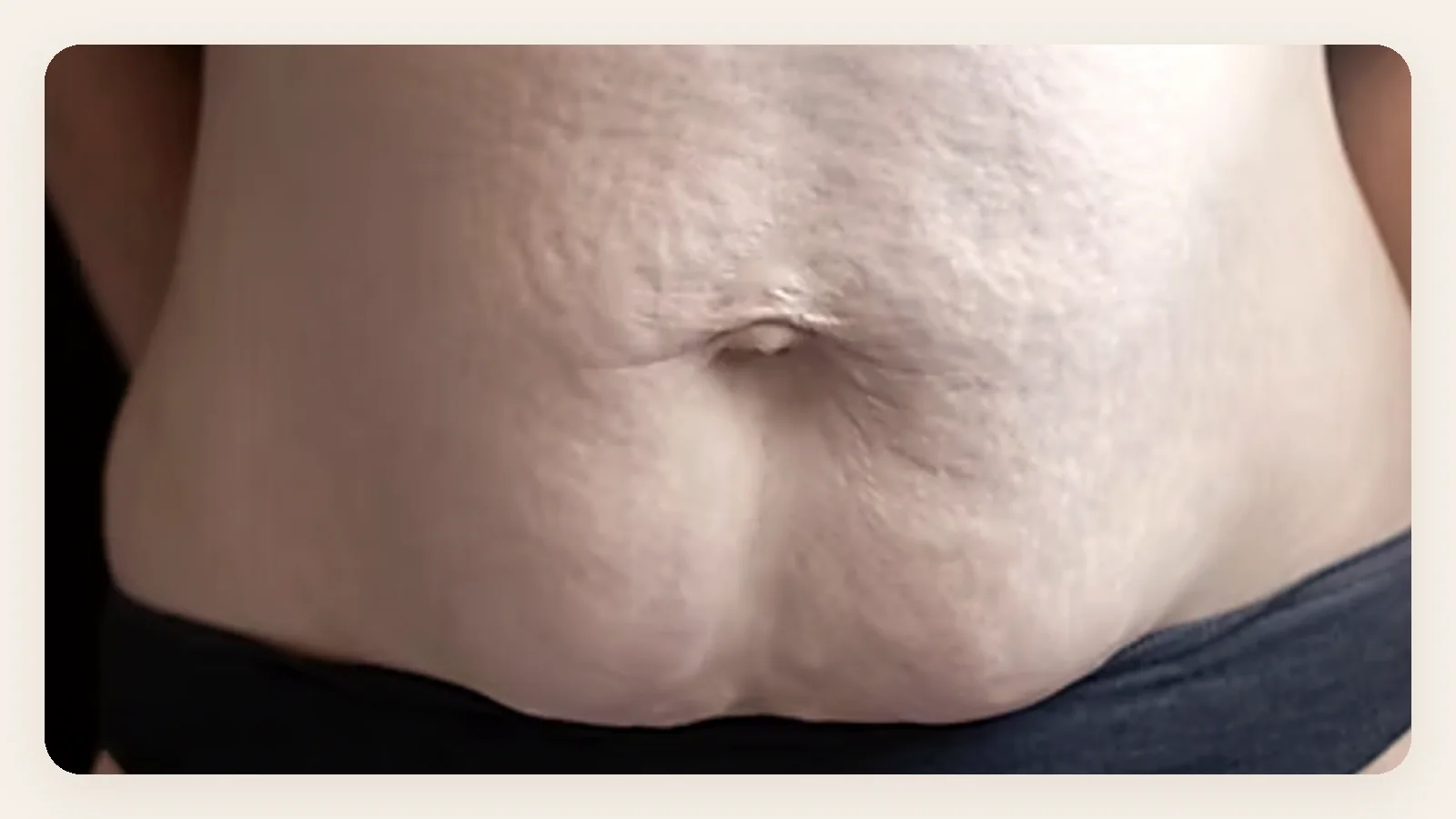
In this article
- What you're checking for
- The setup (30 seconds)
- The two-finger check, step by step
- Step 1: lie down
- Step 2: find your landmarks
- Step 3: lift your head
- Step 4: press and feel
- Step 5: repeat in three spots
- Reading your result
- A note on the "doming" sign
- What NOT to do based on your result
- When you can't feel anything clearly
- After the check, what to do
- Retesting: track your progress
- FAQs
- How wide is a "normal" gap?
- Can I check myself during pregnancy?
- What if my gap is different in different places?
- Do I need an ultrasound?
- Can men or non-postpartum women have diastasis?
- How often should I retest?
The single most useful skill in early postpartum recovery is knowing whether you have diastasis recti. You don't need a doctor's appointment or an ultrasound to find out. The two-finger self-check is the same test most women's health physios use as a first pass, and you can do it right now, on your bedroom floor, in about a minute.
Here's exactly how.
What you're checking for
Diastasis recti is a widening of the connective tissue (linea alba) between the two vertical strap muscles down the front of your belly. When those muscles get pushed too far apart during pregnancy, they may not come back together on their own after birth.
If you haven't read our full explainer yet: What is diastasis recti? gives you the background in 8 minutes. Otherwise, keep reading.
You're checking for two things:
- How wide the gap is (measured in finger-widths)
- How deep and soft it is (tension of the connective tissue)
The width matters, but the quality of the tissue matters more. A 3-finger gap with firm tension often needs less rehab than a 2-finger gap with soft, sinky tissue.
The setup (30 seconds)
You need:
- A flat surface (bed or floor)
- No belt, no jeans, easy access to your belly
- Empty bladder (a full one changes how your abs sit)
Ideally check yourself:
- Not immediately after eating
- Not right after a workout (muscles are pumped, gap looks smaller than it is)
- Not during your period (bloating changes the picture)
- At the same time of day when you're re-testing later
The two-finger check, step by step
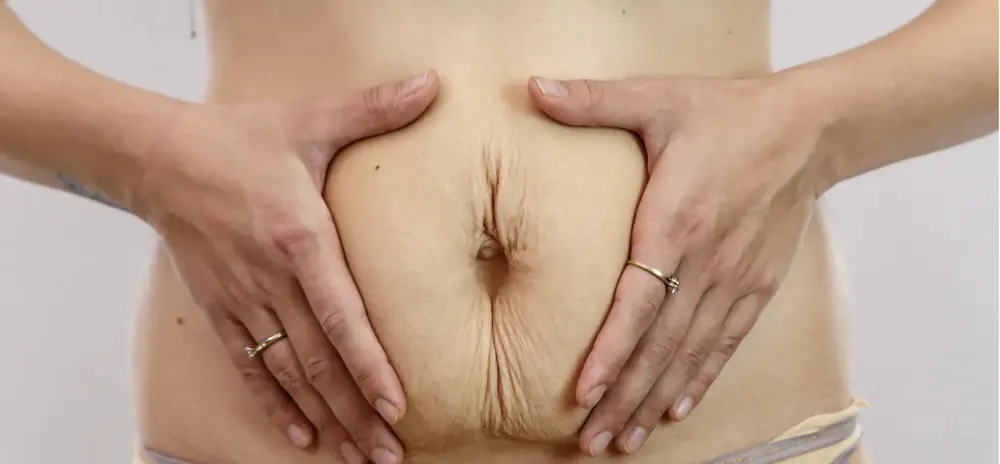 This is what the check actually looks like: two fingers pressed gently into the midline, feeling for the gap between the muscle walls.
Step 1: lie down
Lie flat on your back on the bed or floor. Bend your knees, feet flat, roughly hip-distance apart. Rest your head on the surface. Take one relaxed breath in and out.
Step 2: find your landmarks
Place two fingers of your dominant hand directly on your midline, just above your belly button, fingertips pointing down toward your feet. Press gently, no pressure yet.
Step 3: lift your head
Slowly lift only your head off the surface, keeping shoulders relaxed. You should feel a mild engagement in the outer layer of your abs. Don't do a crunch, just lift the head.
Step 4: press and feel
As you lift, press your fingers gently into the midline. What you're feeling for:
- A firm wall of muscle on either side of your fingers, this is the rectus abdominis
- How many finger-widths fit between those walls at the deepest point
- How much your fingers sink downward before the connective tissue stops them
Step 5: repeat in three spots
Slowly move your fingers to three places:
- 2 cm above the navel (the most common site of separation)
- At the navel itself
- 2 cm below the navel
Diastasis often isn't uniform. Many women have a wide gap above the navel and a tighter one below (or vice versa).
Reading your result
Line up your finding against this scale:
| Finger-widths | Interpretation |
|---|---|
| 0–1 finger | Normal, healthy tension |
| 1–2 fingers | Mild diastasis, common early postpartum, usually resolves with rehab in 8–12 weeks |
| 2–3 fingers | Moderate diastasis, respond well to a structured 12-week program |
| 3–4 fingers | Significant diastasis, needs progressive rehab, usually 4–6 months of consistent work |
| 4+ fingers | Severe, consider seeing a women's health physio in person as well |
Now the tension check:
- If the gap springs back firmly as your fingers sink less than 1 cm, the connective tissue is holding well
- If your fingers sink 2 cm or more before meeting resistance, the tissue is thin and needs more time regardless of width
A note on the "doming" sign
Watch the strip of skin down your midline as you lift your head. If you see a visible dome, ridge or tent-shape pushing up, that is your abdominal contents pushing through a weakened linea alba. Doming is a stronger sign than gap width alone that your core needs rehab before you return to any intense abdominal work.
What NOT to do based on your result
Whatever your gap size, stop doing these until you've done at least 6–8 weeks of targeted rehab:
- Crunches, sit-ups, bicycles
- Full planks held to fatigue
- Boat pose, V-ups, hollow holds
- Heavy overhead lifting
- Anything that visibly domes your belly
Read our detailed guide: What NOT to do with diastasis recti.
When you can't feel anything clearly
Some mums, especially in the first 3 months postpartum or if there's a layer of soft tissue on the belly, can't feel a clear "wall" of muscle. In that case:
- Try again in a week or two, the picture becomes clearer as swelling reduces
- Ask your partner to look at your midline from the side as you sit up from lying, sometimes the dome is visible even when the gap isn't obviously palpable
- If in doubt, book a one-time visit with a women's health physio for a professional exam
After the check, what to do
If you have any degree of diastasis:
- Start with lateral breathing and pelvic floor coordination, our lateral breathing guide walks you through it
- Avoid the exercises listed above
- Consider a structured program, the Mum21 12-Week Recovery Program is exactly this
- Retest yourself every 4 weeks at the same time of day
If you have no diastasis:
- Excellent, but still avoid crunches for the first 12 weeks postpartum
- Build your core from the inside out with breath work first, then progress
- Diastasis can still develop with poor exercise choices, so form matters
Retesting: track your progress
Retest at the same time of day, same conditions, every 4 weeks. Take a note on your phone with:
- Gap in each of 3 locations
- Tension (firm / medium / soft)
- Doming (yes / no)
Progress is rarely dramatic week to week, but 8 weeks of good rehab almost always shows a 1 cm improvement somewhere. That's your evidence you're on the right track.
FAQs
Because this guide mentions…
- Diastasis Recti GuideAssess the gap, understand what closes it, and progress safely.
- Lateral Breathing BasicsThe breathing mechanic every deep-core exercise is built on.
- Belly Doming ExplainedWhat doming signals about pressure management, and how to stop it.
- Pregnancy GuidesSafe loading and prevention across all three trimesters.
Written by
Ana (Anastasia Uvarova)
Women's Health Physiotherapist
UK-qualified physiotherapist, founder of Alpha Physio Care
UK-qualified women's health physiotherapist and founder of Alpha Physio Care. Ana designed the Mum21 12-week recovery program.
Medically reviewed by
Mum21 Clinical Team
Editorial and clinical review
Physiotherapy-led editorial team
The Mum21 editorial team works with practising women's health physiotherapists to keep every guide accurate and current.
Last clinical review: 3 August 2026
Part of the Diastasis Recti topic hub, a physiotherapist-reviewed collection of guides on diastasis recti.
Join 10,000+ Mums
Honest, physio-backed postpartum recovery tips in your inbox. One email a week. No spam, ever.
No spam. Unsubscribe in one click.
Continue reading
The next steps in the diastasis recti learning path.
- Postpartum Recovery When You Live Outside IndiaYou had your baby in Sydney, London, Toronto, or Dubai, not Mumbai or Bangalore. The confinement support, the physio who understands your context, the culturally familiar guidance — none of it automatically travels with you. Here's what actually matters, wherever you are. 6 min read · Diastasis Recti
- Pregnant Again With Diastasis Recti: What Changes the Second TimeOne study found the single biggest jump in gap width happens between the first and second pregnancy, not the third or fourth. If you're expecting again and never fully closed from last time, here's what that actually means. 7 min read · Diastasis Recti
- How Accurate Is the Finger Test for Diastasis Recti, Really?Your own fingers are a genuinely reliable way to track your own progress over time. They're not the same as an ultrasound. Here's exactly what each is actually good for. 6 min read · Diastasis Recti
Related topics
C-Section Recovery
Physio-led guidance on cesarean healing: scar mobility, the C-section shelf, safe timelines and exactly when to restart core work after your surgery.
11 guidesPelvic Floor
Leaks, heaviness, pressure management and pelvic floor training after birth, explained step by step by a UK-qualified women's health physiotherapist.
4 guidesCore Recovery
Deep core activation, breathing mechanics and progressive strength work that rebuild the postpartum core without doming, coning or pelvic floor strain.
14 guides