What NOT to Do With Diastasis Recti (The Definitive List)
In this article
- The core principle
- Exercises to avoid (with reasons)
- Crunches, sit-ups, bicycle abs
- Full planks held to fatigue
- V-ups, hollow holds, boat pose
- Full sit-ups from lying to standing
- Russian twists
- Heavy overhead lifts
- Full push-ups
- Bicep curls done with a "belly out" posture
- Running and jumping in the first 12 weeks
- Weighted twisting sports too early
- Daily habits to change
- Sitting up straight from lying
- Carrying baby only on one hip
- Sitting hunched during feeds
- Straining on the toilet
- Coughing or sneezing "open"
- Wearing tight waistbands
- "Sucking in" all day
- Yoga poses to avoid or modify
- What you CAN do
- The one non-negotiable rule
- A structured way forward
- FAQs
- Can I ever do crunches again?
- Are planks always bad for diastasis?
- Is running bad for diastasis?
- Can I lift weights with diastasis?
- What if my gym instructor says all exercise is fine?
- How will I know when I'm ready to progress?
The single biggest reason women don't heal from diastasis recti isn't lack of effort. It's that the exercise they're doing every day is silently making the separation worse. Well-meaning gym instructors, WhatsApp workout videos, and Instagram fitness influencers routinely prescribe movements that dome the belly and pull the linea alba further apart.
If you've been told to "do more planks" or "hit those abs", stop. Here's the full list of what to avoid, why, and what to do instead.
The core principle
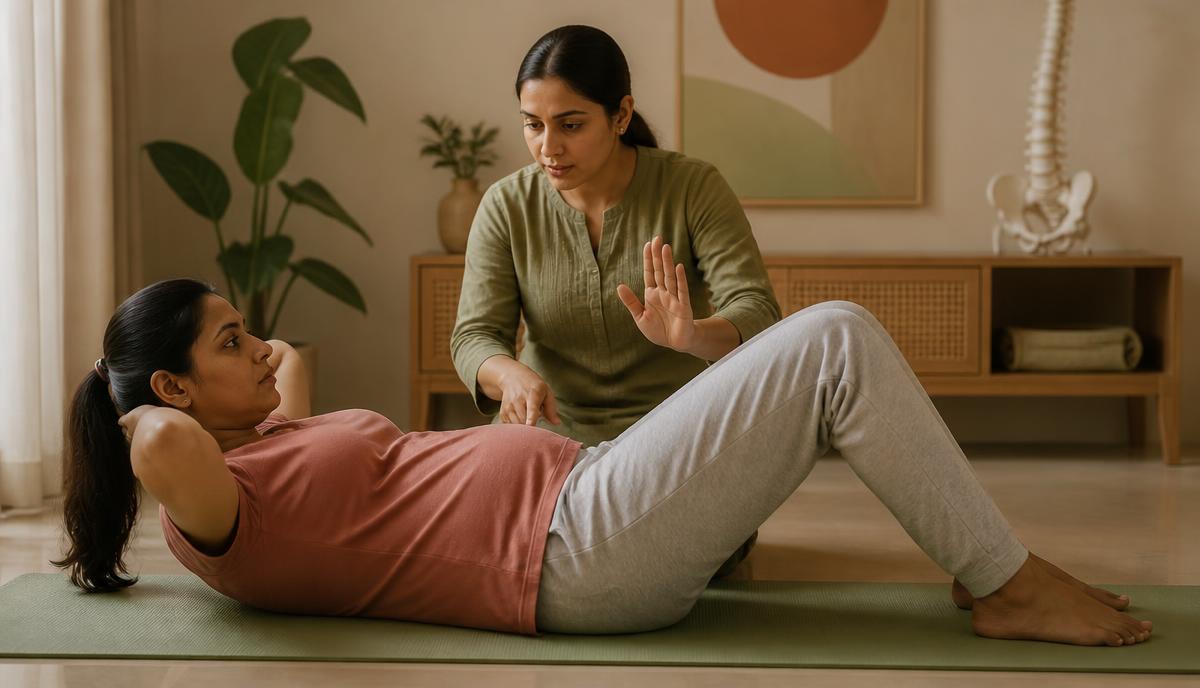
Any movement that creates downward or outward pressure on the abdominal wall without proper deep core engagement will widen a diastasis. You can spot these movements by the "doming" test: as you do the movement, look at the strip of skin down your midline. If you see a dome, ridge, or tent-shape push up, that movement is not for you right now.
Exercises to avoid (with reasons)
Crunches, sit-ups, bicycle abs
The classic. When you crunch, the outer rectus abdominis contracts strongly while the deep core is often disengaged. This pushes the abdominal contents outward through the weakened midline, exactly the shape of the mom pooch. Crunches actively widen the gap.
Instead: Head lifts with active exhale + pelvic floor engagement, progressed slowly.
Full planks held to fatigue
A plank at 100% effort held for a minute drops the belly toward the floor as your form breaks. Every second past your form limit is worsening the diastasis.
Instead: Modified plank on knees, holds under 20 seconds, breathing throughout. Progress duration only when form stays perfect.
V-ups, hollow holds, boat pose
Long-lever loading through the trunk with the abs strongly contracted. Almost always domes in someone with active diastasis.
Instead: Bird-dog, dead-bug (with knees bent, small ranges), toe taps lying down.
Full sit-ups from lying to standing
Especially the yoga "roll up" and Pilates full sit-up. High doming risk. Also stresses the neck and lower back.
Instead: Log-roll to your side and push up with your arms.
Russian twists
Weighted twists load the linea alba obliquely, creating a shearing force across the tissue that's most vulnerable to widening.
Instead: Gentle standing rotations with breath coordination, no added weight.
Heavy overhead lifts
Loading a weight overhead requires either a properly braced core or, if the core can't brace, arching the lower back and pushing the belly forward. If your deep core isn't ready, this pushes outward.
Instead: Landmine press, kettlebell rack-hold squats, dumbbell rows. Overhead work returns once the deep core is strong.
Full push-ups
Same problem as a plank at fatigue, the belly drops and creates outward pressure.
Instead: Wall push-ups, then incline push-ups on a bench, progressing to knee push-ups.
Bicep curls done with a "belly out" posture
Look at a mirror during standing curls. If your rib cage flares up and your belly pushes forward, you're loading the linea alba. Fix your posture before adding weight.
Instead: Ribs down, pelvis neutral, exhale on the lift, or seated curls with back supported.
Running and jumping in the first 12 weeks
Not because of the impact on your knees (mostly fine) but because of the impact on your pelvic floor and abdominal wall. Running before the deep core is strong = more prolapse risk, more leaking, more diastasis stress.
Instead: Fast walking with proper posture, low-impact cardio (elliptical, stationary bike), swimming after 8 weeks.
Weighted twisting sports too early
Tennis, badminton, cricket batting, golf, all involve rapid loaded rotation. Return only after your core is strong (usually 3–4 months of rehab).
Instead: Walking, swimming, cycling, stability-focused strength training in the meantime.
Daily habits to change
Exercises aren't the whole picture. What you do 100 times a day matters more than what you do 3 times a week.
Sitting up straight from lying
Every time you sit straight up from bed, you're doing a mini crunch under load. Multiply that by 5 wake-ups a night with the baby, and you've done 35 crunches a week without knowing it.
Fix: Always log-roll. Turn to your side, drop your feet off the bed, use your arm to push up.
Carrying baby only on one hip
Chronic one-sided loading pulls your pelvis out of neutral and asymmetrically loads the abdominal wall.
Fix: Alternate sides deliberately. Use a good carrier for longer holds. Learn "pelvis-neutral" carrying with the baby closer to your midline.
Sitting hunched during feeds
Rounded shoulders and a forward head compress the rib cage down onto the belly, giving the deep core no room to work. Over 12 feeds a day, this posture becomes your default.
Fix: Bring the baby to you with a nursing pillow, don't take yourself to the baby. Ribs stacked over pelvis. Shoulders down and back.
Straining on the toilet
Every time you push hard, you're firing pressure downward onto the pelvic floor and outward through the weakest point of the abdominal wall.
Fix: Address constipation aggressively, water, fibre, magnesium citrate at night, a step under your feet on the toilet so your knees are above your hips. Never push, exhale and let gravity do the work.
Coughing or sneezing "open"
Uncontrolled coughs and sneezes push massive pressure through the abdominal wall.
Fix: When you feel a sneeze coming, turn your head, close your mouth partly, and gently pull your belly button toward your spine. Every single sneeze.
Wearing tight waistbands
Anything that grips your midsection and pushes inward from the outside makes your deep core switch off. Long-term wear leads to reliance and further weakness.
Fix: Loose, high-waisted, soft-waistband clothing. Reserve postpartum belts for the first 4 weeks after a C-section only, and only during activity.
"Sucking in" all day
Sucking in isn't the same as engaging your deep core. It's a static bracing that shuts down normal breathing and, over time, teaches your abs to disengage during movement.
Fix: Learn true transversus abdominis activation on the exhale. See our lateral breathing guide.
Yoga poses to avoid or modify
Many yoga classes assume a strong core. If yours doesn't:
- Avoid: full boat, hollow hold, deep upward-facing dog, full wheel, deep camel, jump-throughs, full plank flows
- Modify: down-dog with knees soft, cobra with elbows bent, chair pose with pelvis tucked slightly, plank on knees, cat-cow instead of chatarunga
What you CAN do
Everything else, essentially. With a diastasis, safely trainable:
- Walking (any speed you can maintain nasal breathing)
- Swimming (freestyle and back stroke, avoid heavy breaststroke kick if you have hip issues)
- Cycling (upright bikes, not aggressive road position)
- Yoga with modifications
- Pilates focused on deep core (not intermediate/advanced mat)
- Strength training focused on legs, glutes, back, arms with proper posture
- Bodyweight moves like bridges, clamshells, wall sits, glute kickbacks
- Loaded carries with correct posture (great for functional strength)
The one non-negotiable rule
Watch for doming during every exercise. If any move produces a visible ridge or dome down your midline, that move is not for you today. Regress it, reduce load, or replace it entirely.
You can return to almost everything on this "avoid" list after 8–16 weeks of dedicated rehab. Nothing is off-limits forever. But doing them before you're ready sets your recovery back by months.
A structured way forward
The reason we built the Mum21 12-Week Recovery Program is that you shouldn't have to memorise a list of "do's and don'ts" and audit every exercise class you attend. The program gives you 114 physio-designed videos, all pre-vetted for diastasis-safe form, in a clear weekly progression. No guessing, no doming, no setbacks.
FAQs
Because this guide mentions…
- Pelvic Floor GuideWhy leaks and heaviness happen, and how to train the floor properly.
- Belly Doming ExplainedWhat doming signals about pressure management, and how to stop it.
- Lateral Breathing BasicsThe breathing mechanic every deep-core exercise is built on.
- Diastasis Recti GuideAssess the gap, understand what closes it, and progress safely.
Written by
Ana (Anastasia Uvarova)
Women's Health Physiotherapist
UK-qualified physiotherapist, founder of Alpha Physio Care
UK-qualified women's health physiotherapist and founder of Alpha Physio Care. Ana designed the Mum21 12-week recovery program.
Medically reviewed by
Mum21 Clinical Team
Editorial and clinical review
Physiotherapy-led editorial team
The Mum21 editorial team works with practising women's health physiotherapists to keep every guide accurate and current.
Last clinical review: 15 July 2026
Part of the Diastasis Recti topic hub, a physiotherapist-reviewed collection of guides on diastasis recti.
Join 10,000+ Mums
Honest, physio-backed postpartum recovery tips in your inbox. One email a week. No spam, ever.
No spam. Unsubscribe in one click.
Continue reading
The next steps in the diastasis recti learning path.
- Postpartum Recovery When You Live Outside IndiaYou had your baby in Sydney, London, Toronto, or Dubai, not Mumbai or Bangalore. The confinement support, the physio who understands your context, the culturally familiar guidance — none of it automatically travels with you. Here's what actually matters, wherever you are. 6 min read · Diastasis Recti
- Pregnant Again With Diastasis Recti: What Changes the Second TimeOne study found the single biggest jump in gap width happens between the first and second pregnancy, not the third or fourth. If you're expecting again and never fully closed from last time, here's what that actually means. 7 min read · Diastasis Recti
- How Accurate Is the Finger Test for Diastasis Recti, Really?Your own fingers are a genuinely reliable way to track your own progress over time. They're not the same as an ultrasound. Here's exactly what each is actually good for. 6 min read · Diastasis Recti
Related topics
C-Section Recovery
Physio-led guidance on cesarean healing: scar mobility, the C-section shelf, safe timelines and exactly when to restart core work after your surgery.
11 guidesPelvic Floor
Leaks, heaviness, pressure management and pelvic floor training after birth, explained step by step by a UK-qualified women's health physiotherapist.
4 guidesCore Recovery
Deep core activation, breathing mechanics and progressive strength work that rebuild the postpartum core without doming, coning or pelvic floor strain.
14 guides