Lateral Breathing, The One Exercise That Restarts Your Core
In this article
If you only learn one thing in your first month postpartum, learn this: how to breathe laterally. It sounds underwhelming. It's the single most important skill for rebuilding your core.
Why your core "forgot" how to work
During pregnancy, your diaphragm gets pushed up, your abs stretch out, and your pelvic floor takes nine months of constant load. The neural connection between your brain and your deep core muscles literally gets quieter. You can't strengthen what you can't feel.
What lateral breathing is
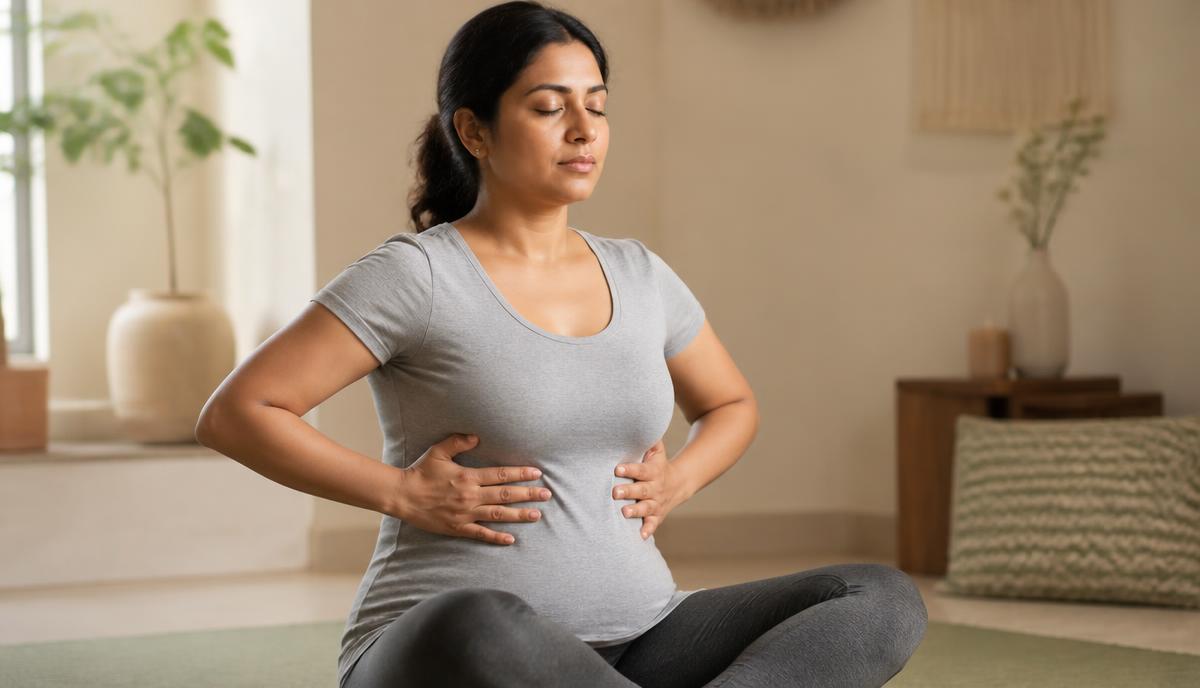
Most of us breathe vertically, chest up, belly out. Lateral breathing is the opposite: you keep your belly soft and let the sides and back of your ribcage expand on the inhale.
When you exhale slowly, the deepest abdominal muscle (transversus abdominis) and your pelvic floor engage together, like a corset gently tightening from the inside.
Try it now
- Sit tall or lie on your back with knees bent
- Wrap your hands around the sides of your lower ribs
- Inhale through your nose for 4 counts, feel your ribs widen sideways into your hands. Belly stays soft.
- Exhale through pursed lips for 6 counts, feel your ribs draw in and your lower belly gently flatten
- Repeat 10 times
That gentle flattening on the exhale is your deep core waking up.
When to do it
Anytime. Feeding the baby. Stuck in traffic. Lying down before sleep. Aim for 3 short sessions a day of 10 breaths each in your first two weeks.
What changes
Mums who practice lateral breathing daily for 2 weeks usually report:
- Lower back feels supported again
- Less "doming" when they sit up
- Easier to engage their abs in other movements
- A surprising calm, slow exhales activate your parasympathetic nervous system
It's not glamorous. It's not Instagrammable. But it's the foundation everything else is built on.
Because this guide mentions…
- Pelvic Floor GuideWhy leaks and heaviness happen, and how to train the floor properly.
- Why the Mum Pooch StaysThe difference between fat, bloat and true abdominal separation.
- Belly Doming ExplainedWhat doming signals about pressure management, and how to stop it.
- Lower Back Pain After BabyWhy a weak deep core shows up as back pain, and what helps.
Written by
Ana (Anastasia Uvarova)
Women's Health Physiotherapist
UK-qualified physiotherapist, founder of Alpha Physio Care
UK-qualified women's health physiotherapist and founder of Alpha Physio Care. Ana designed the Mum21 12-week recovery program.
Medically reviewed by
Mum21 Clinical Team
Editorial and clinical review
Physiotherapy-led editorial team
The Mum21 editorial team works with practising women's health physiotherapists to keep every guide accurate and current.
Last clinical review: 2 May 2026
Part of the Core Recovery topic hub, a physiotherapist-reviewed collection of guides on core recovery.
Join 10,000+ Mums
Honest, physio-backed postpartum recovery tips in your inbox. One email a week. No spam, ever.
No spam. Unsubscribe in one click.
Continue reading
The next steps in the core recovery learning path.
- Can You Do Planks With Diastasis Recti? What to Check Before You TryThe honest answer isn't yes or no — it's 'depends which plank, and whether your body shows the one sign that means stop.' Here's how to tell, and what to do instead if it's not yet. 7 min read · Core Recovery
- A 5-Minute Core Check That Won't Make You Feel WorseA gentle 5-minute self-check to understand your postpartum belly without forcing anything or adding pressure. 7 min read · Core Recovery
- Postpartum Hip and Pelvic Mobility, The Missing PieceA stiff pelvis is a leaky pelvis. Mobility work is the quiet accelerator most postpartum programs skip, and it fixes symptoms strength alone can't. 5 min read · Core Recovery
Related topics
Diastasis Recti
Everything on diastasis recti in one place: how to check your gap at home, what closes it, what makes it worse and how long real recovery actually takes.
15 guidesC-Section Recovery
Physio-led guidance on cesarean healing: scar mobility, the C-section shelf, safe timelines and exactly when to restart core work after your surgery.
11 guidesPelvic Floor
Leaks, heaviness, pressure management and pelvic floor training after birth, explained step by step by a UK-qualified women's health physiotherapist.
3 guides