C-Section Shelf, What Causes the Overhang and What Actually Reduces It
In this article
- What the shelf actually is
- Why some scars tether more than others
- What actually reduces it
- What physio realistically can't fix
- The Mum21 program and the shelf
- FAQs
- Will my C-section shelf ever go away completely?
- Is the C-section shelf the same as diastasis recti?
- Can I fix my C-section shelf without surgery?
- When should I start worrying about my C-section shelf?
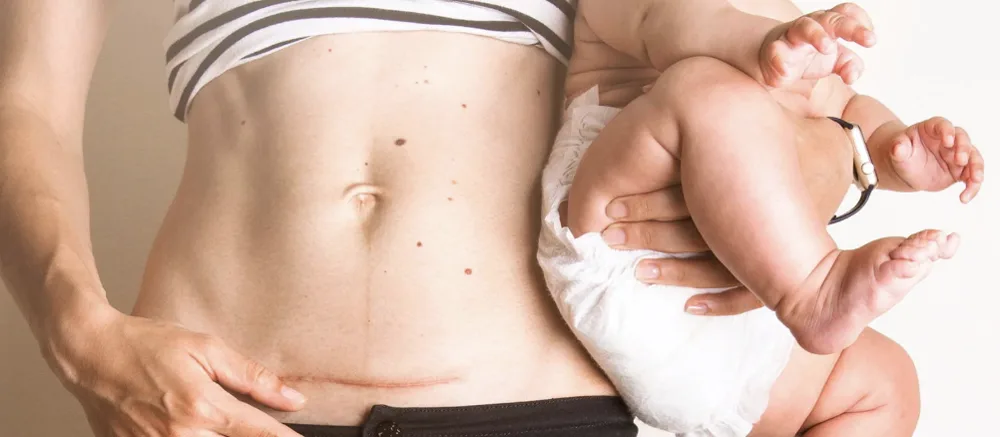
You're months, maybe years, past your C-section. The incision healed fine. But there's still a soft pouch sitting just above the scar line, and it doesn't move the way the rest of your stomach does when you tense your abs. It has a name: the C-section shelf, and almost nobody warns you about it before it shows up.
The frustrating part isn't that it exists. It's that most advice you'll find online is either "just do more crunches" (it won't move that way) or "it's permanent, live with it" (also not quite true). The real answer is more specific, and more useful, than either.
What the shelf actually is
A C-section cuts through seven layers to reach your baby: skin, fat, fascia, muscle sheath, muscle, another fascia layer, and peritoneum. All of those layers heal and reattach to each other, and the shelf is what you feel when that healing goes slightly wrong in one of three ways, often more than one at once.
Scar tethering. The scar itself pulls the skin and fascia above it inward, so the tissue just above the pull sits proud, like fabric bunching above a tight seam.
Residual diastasis. The muscle separation from pregnancy doesn't automatically close just because you delivered by C-section, and a gap directly above the scar line reads as a soft bulge.
Fat and skin laxity. Pregnancy stretches skin and adds fat storage in the lower abdomen. Some of that settles on its own; some doesn't, especially with more than one C-section.
Why some scars tether more than others
Research on scar appearance is more useful here than it sounds. A meta-analysis of scar characteristics found that depressed (indented) scars were positively associated with underlying adhesions, while flat scars predicted their absence. If you can see or feel that your scar sits slightly recessed rather than flush with the surrounding skin, that's a reasonable sign there's tethering underneath it, not just at the surface.
Surgical technique plays a role too: studies on closure methods have found that how the rectus muscle and peritoneum are closed during surgery measurably affects how much adhesion forms afterward. That part was decided in the operating theatre, not by anything you did or didn't do in recovery, worth remembering if you've been quietly blaming yourself for how your belly looks.
What actually reduces it
None of this responds to core exercises alone, and it doesn't respond to scar work alone either. It responds to both, done in the right order.
Weeks 6–8: scar mobilisation, once cleared. Once your scar is fully closed, non-tender, and shows no discharge, usually 6–8 weeks, gentle scar massage improves fascial glide and reduces the tethering that creates the shelf. We cover the exact technique in our C-section recovery timeline.
Weeks 6–12: deep core re-education. The shelf includes a diastasis component in most women, and diastasis closes through deep core sequencing (breath, transverse abdominis, load), not surface crunches. Start with our how to check yourself for diastasis recti guide so you know your actual starting gap.
Months 3–6: scar reaches mature strength. This is the real window where scar mobilisation work compounds. A study measuring abdominal wall scar quality found it predicted pelvic floor rehabilitation outcomes months later, scar health and core function aren't separate projects, they're the same one.
What physio realistically can't fix
This is the part most content in this space won't say plainly. Scar mobilisation and deep core work reduce most of the shelf for most women over 6–12 months. They do not remove excess skin, and they don't fully resolve a diastasis wider than about 3cm on their own. If your gap is still wide and unchanged after a genuinely consistent 12-week program, that's a fair point to raise with a physio or surgeon about next steps, not a sign you did something wrong.
The Mum21 program and the shelf
The 12-Week Recovery Program sequences exactly this: scar-safe breathing and pelvic floor work from week 1, deep core loading from week 6 for C-section mothers with clearance, and progressive strength through week 12. It won't touch loose skin, but it directly targets the tethering and diastasis components, the two parts of the shelf that are actually trainable.
FAQs
Because this guide mentions…
- C-Section RecoveryScar mobility, the C-section shelf and a safe return to core work.
- Pelvic Floor GuideWhy leaks and heaviness happen, and how to train the floor properly.
- Diastasis Recti GuideAssess the gap, understand what closes it, and progress safely.
- Pregnancy GuidesSafe loading and prevention across all three trimesters.
Clinical references
- Postoperative adhesion development after cesarean section, a reviewpmc.ncbi.nlm.nih.gov
- Cesarean scar characteristics predict pelvic adhesions, meta-analysisPMID 27072887
- Rectus muscle and peritoneum closure technique and intra-abdominal adhesionsPMID 22463952
- Abdominal wall scar score predicts pelvic floor rehabilitation outcomesPMC10506580
Mum21 guides cite peer-reviewed research and professional physiotherapy guidance. They are educational and do not replace individual medical care.
Written by
Ana (Anastasia Uvarova)
Women's Health Physiotherapist
UK-qualified physiotherapist, founder of Alpha Physio Care
UK-qualified women's health physiotherapist and founder of Alpha Physio Care. Ana designed the Mum21 12-week recovery program.
Medically reviewed by
Mum21 Clinical Team
Editorial and clinical review
Physiotherapy-led editorial team
The Mum21 editorial team works with practising women's health physiotherapists to keep every guide accurate and current.
Last clinical review: 2 August 2026
Part of the C-Section Recovery topic hub, a physiotherapist-reviewed collection of guides on c-section recovery.
Join 10,000+ Mums
Honest, physio-backed postpartum recovery tips in your inbox. One email a week. No spam, ever.
No spam. Unsubscribe in one click.
Continue reading
The next steps in the c-section recovery learning path.
- Weight Loss After a C-Section: What Actually Changes, and WhenA realistic, physio-backed answer, not a 30-day plan promising your old body back. What's different about weight after a C-section specifically, and what actually helps. 7 min read · C-Section Recovery
- Is Yoga Safe After a C-Section? A Physio's Honest AnswerThe honest answer is "it depends on the pose and the week," not yes or no. Here's which yoga is genuinely safe after a C-section, which isn't yet, and why the difference matters. 6 min read · C-Section Recovery
- C-Section Recovery Tips: A Physio's Real Punch ListNot a generic "listen to your body" list. Specific, week-anchored things a women's health physio actually tells C-section patients, including the ones nobody mentions before you go home. 8 min read · C-Section Recovery
Related topics
Diastasis Recti
Everything on diastasis recti in one place: how to check your gap at home, what closes it, what makes it worse and how long real recovery actually takes.
15 guidesPelvic Floor
Leaks, heaviness, pressure management and pelvic floor training after birth, explained step by step by a UK-qualified women's health physiotherapist.
3 guidesCore Recovery
Deep core activation, breathing mechanics and progressive strength work that rebuild the postpartum core without doming, coning or pelvic floor strain.
9 guides