Do Postpartum Belly Wraps and Support Belts Actually Close Your Gap?
In this article
- The trial that actually measured this
- So why do so many mothers say their wrap "helped"?
- What does move the needle, based on the same body of evidence
- The bottom line
- FAQs
- Should I stop wearing my postpartum belt if I have one?
- Are waist trainers the same as postpartum recovery belts?
- Is there any harm in wearing a belt too much?
- What actually works for the "loose, unsupported" feeling if not a belt?
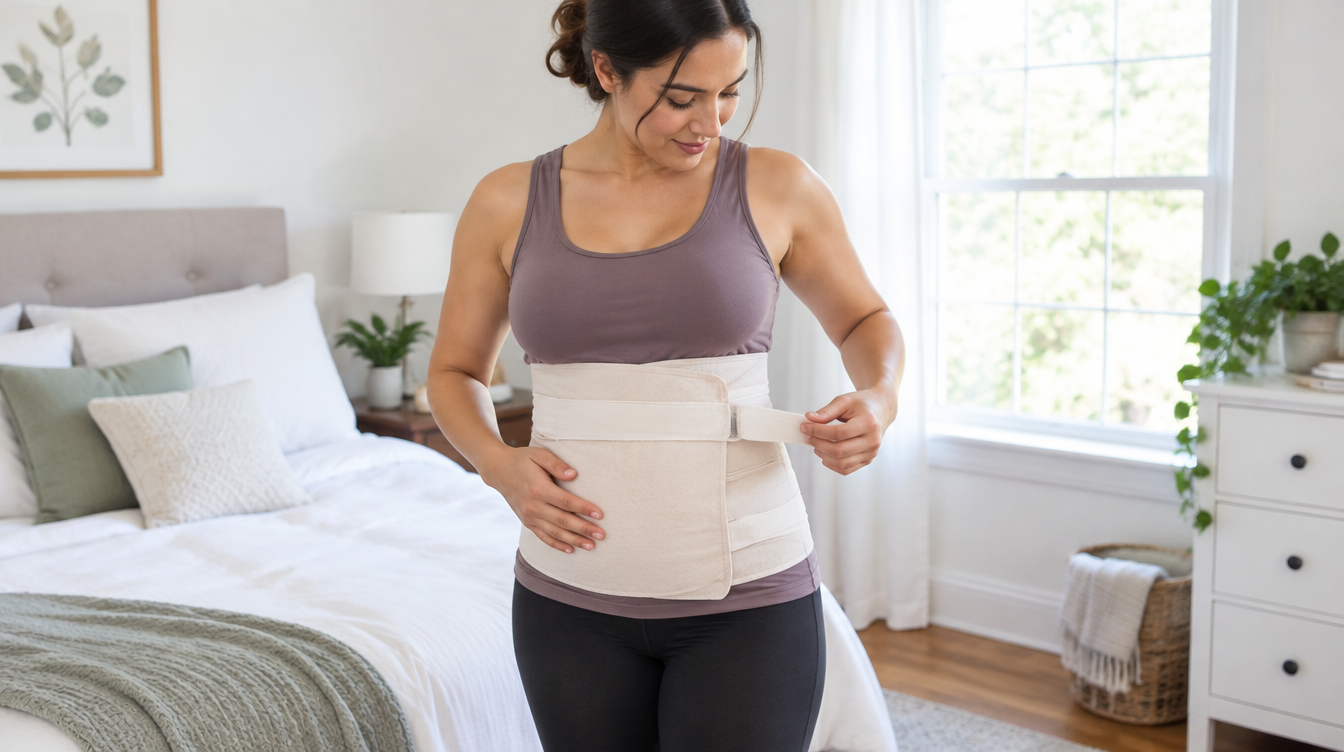
Walk into any pharmacy or scroll any postpartum product page and you'll find the same promise on a belly wrap, a rigid support belt, or a "postpartum recovery" waist trainer: wear this and your core snaps back. It's a specific, testable claim — so it's worth asking whether it's actually been tested. It has. We covered the cultural tradition of belly binding across India, China, and Southeast Asia separately — this is about the narrower, modern, commercial claim: does wearing one of these products close your diastasis recti gap?
The trial that actually measured this
A 2023 randomized clinical trial put two of the most common products head to head — Tubigrip (a stretchy compression wrap) and a rigid abdominal belt — over the first 8 weeks postpartum, with ultrasound measuring the actual gap width before and after, in 62 women.
The result: gap width dropped by an average of 46%, from 4.6cm to 2.5cm, over the 8 weeks — with no significant difference between the wrap group, the belt group, or natural healing. Women who wore Tubigrip wore it for far longer on average (278 hours vs. 81 hours for the belt group) than those in the belt group, and that extra wear time made no measurable difference to the outcome either. The researchers' own conclusion was direct: it's questionable whether either support improves on what natural healing alone would have done.
So why do so many mothers say their wrap "helped"?
Because it did — just not by closing the gap. This isn't a contradiction, it's a distinction worth understanding:
- Physical support and comfort while healing, especially in the first days and weeks — real, and worth having if it helps you move and feel steadier
- A sense of "holding things together" that can genuinely reduce the feeling of looseness or vulnerability in your midline
- Posture cueing — some women find a wrap encourages more upright posture, indirectly helping how the deep core engages
None of that is nothing. It's just a different claim than "closes your diastasis recti," which is the specific claim on most product pages and the one the actual research doesn't support.
What does move the needle, based on the same body of evidence
The meta-analysis comparing exercise to binding found structured abdominal exercise reduces the gap below the umbilicus more effectively than binding or no intervention at all — the opposite of what a product page selling a belt will tell you. The honest hierarchy, based on the actual research:
- Structured, sequenced deep-core training — the intervention with real evidence of outperforming passive support
- Time and natural healing — real, substantial, and free, especially in the first 6 months
- A support garment for comfort — legitimate for how it feels, not for what it closes
The bottom line
If a wrap or belt makes you feel more comfortable and supported while you heal, that's a real and valid reason to wear one — nobody needs to talk you out of comfort in the fourth trimester. Just hold that separately from any claim that it's doing the work of closing your gap. On the actual evidence, that part is down to time and structured training, not the product around your middle.
FAQs
Because this guide mentions…
- Diastasis Recti GuideAssess the gap, understand what closes it, and progress safely.
- Pelvic Floor GuideWhy leaks and heaviness happen, and how to train the floor properly.
- Lateral Breathing BasicsThe breathing mechanic every deep-core exercise is built on.
- Pregnancy GuidesSafe loading and prevention across all three trimesters.
Clinical references
- Tubigrip and rigid belt RCT, Musculoskelet Sci Pract 2023PMID 36577592
- Comparative efficacy of abdominal exercise vs binding, meta-analysisonlinelibrary.wiley.com
Mum21 guides cite peer-reviewed research and professional physiotherapy guidance. They are educational and do not replace individual medical care.
Written by
Ana (Anastasia Uvarova)
Women's Health Physiotherapist
UK-qualified physiotherapist, founder of Alpha Physio Care
UK-qualified women's health physiotherapist and founder of Alpha Physio Care. Ana designed the Mum21 12-week recovery program.
Medically reviewed by
Mum21 Clinical Team
Editorial and clinical review
Physiotherapy-led editorial team
The Mum21 editorial team works with practising women's health physiotherapists to keep every guide accurate and current.
Last clinical review: 7 September 2026
Part of the Diastasis Recti topic hub, a physiotherapist-reviewed collection of guides on diastasis recti.
Join 10,000+ Mums
Honest, physio-backed postpartum recovery tips in your inbox. One email a week. No spam, ever.
No spam. Unsubscribe in one click.
Continue reading
The next steps in the diastasis recti learning path.
- Postpartum Recovery When You Live Outside IndiaYou had your baby in Sydney, London, Toronto, or Dubai, not Mumbai or Bangalore. The confinement support, the physio who understands your context, the culturally familiar guidance — none of it automatically travels with you. Here's what actually matters, wherever you are. 6 min read · Diastasis Recti
- Pregnant Again With Diastasis Recti: What Changes the Second TimeOne study found the single biggest jump in gap width happens between the first and second pregnancy, not the third or fourth. If you're expecting again and never fully closed from last time, here's what that actually means. 7 min read · Diastasis Recti
- How Accurate Is the Finger Test for Diastasis Recti, Really?Your own fingers are a genuinely reliable way to track your own progress over time. They're not the same as an ultrasound. Here's exactly what each is actually good for. 6 min read · Diastasis Recti
Related topics
C-Section Recovery
Physio-led guidance on cesarean healing: scar mobility, the C-section shelf, safe timelines and exactly when to restart core work after your surgery.
11 guidesPelvic Floor
Leaks, heaviness, pressure management and pelvic floor training after birth, explained step by step by a UK-qualified women's health physiotherapist.
4 guidesCore Recovery
Deep core activation, breathing mechanics and progressive strength work that rebuild the postpartum core without doming, coning or pelvic floor strain.
14 guides