Why Your Belly Still Looks Big After a C-Section (It's Probably Not Fat)
In this article
- The three things it could actually be
- Why "belly fat exercises" don't fix the first two
- How to actually tell the difference
- What actually closes each one
- FAQ
- I've been doing ab workouts for months and nothing changed. Why?
- Can diastasis recti go away with weight loss alone?
- How long after a C-section can I start fixing this?
- Is this the same as "mummy tummy"?
- Where to start
If you've searched "belly fat exercises after C-section" and tried them, and the shape hasn't changed, you're not doing it wrong. You're very possibly solving the wrong problem.
Two different things can be sitting on your lower abdomen after a C-section, and they need completely different fixes. Most belly-fat advice only addresses one of them, and it's often not the one that's actually there.
The three things it could actually be
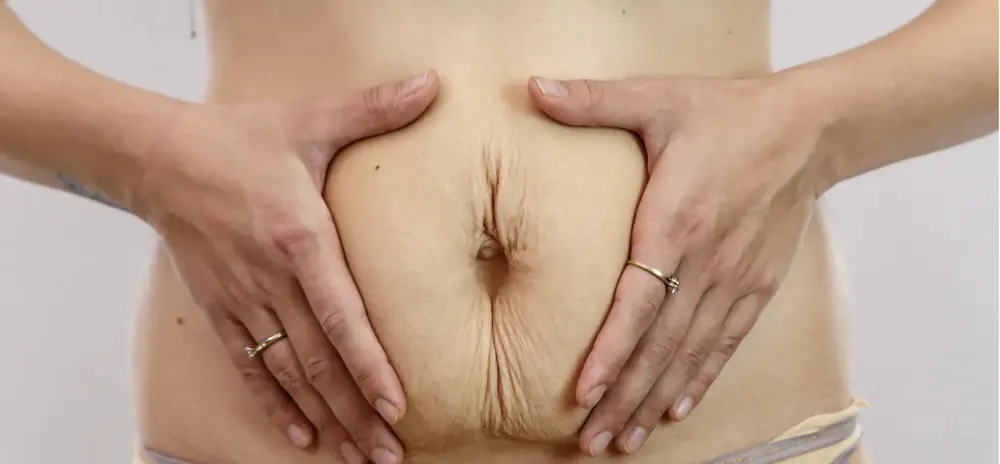
1. Diastasis recti (ab separation). The connective tissue running down the midline of your abdomen, the linea alba, stretches during pregnancy to make room for your baby. For most women it doesn't fully close on its own after delivery. What this looks like: a soft, doming bulge down the centre of your stomach, especially visible when you sit up or strain, that doesn't respond to crunches (crunches can make it worse) or diet.
2. The C-section shelf. A specific, separate issue from diastasis recti: scar tissue and fascia can adhere just above your incision line, creating a firmer, shelf-like ridge that sits differently from soft fat. It responds to scar mobilisation and specific core work, not general weight loss.
3. Actual fat. Real, but usually a smaller part of the picture than it looks like in the mirror, because diastasis recti and the shelf both change the shape of your stomach independent of how much fat is actually there. A flat-stomached woman can still have a visible pooch from separation alone.
Why "belly fat exercises" don't fix the first two
Generic ab exercises, and generic weight-loss advice, are built around the assumption that what's there is fat. If it's diastasis recti or shelf adhesion, that assumption is simply wrong, and the exercises that would normally flatten a stomach (crunches, sit-ups, planks done too early) can actively widen an unhealed gap instead of closing it.
This is the single most common reason "I've tried everything and nothing works" happens: the something being tried was built for the wrong problem.
How to actually tell the difference
A simple check at home: lie on your back, knees bent, feet flat. Lift your head and shoulders slightly off the floor, as if starting a crunch. Place two fingers just above and below your belly button, pressing gently into your midline. If you feel a gap you can sink your fingers into, with the tissue at the bottom feeling soft rather than firm and taut, that's diastasis recti.
The C-section shelf is more straightforward to spot: it's specifically at or just above the horizontal scar line, feels firmer and more rope-like than the soft dome of diastasis recti, and often comes with reduced sensation or a pulling feeling along the scar.
If you're not sure, Mum21's 60-second self-check walks through this with video guidance rather than a written description.
What actually closes each one
For diastasis recti: a specific sequence, in order. Breath and alignment first (learning to engage the deep core, the transverse abdominis, without bracing or bulging). Then progressive core loading, checked at every stage for doming. Skipping straight to "core exercises" without this foundation is the exact mistake that keeps the gap open.
For the C-section shelf: scar mobilisation, once your incision has fully healed (generally not before 6-8 weeks, and only with your doctor's clearance), combined with the same core-loading progression, since the shelf and the surrounding core function aren't actually separate systems.
For genuine excess fat, once the first two are addressed: ordinary, sustainable nutrition and activity work fine, the same as for anyone. It's just rarely the whole story this early, and treating it as the whole story is why so many women feel like they've "failed" at something that was never going to work regardless of effort.
FAQ
Where to start
Mum21's 12-week program addresses both, in the order your body needs: alignment and breath first, then scar-safe core loading, specific to C-section recovery. See the C-section track, or start with the free self-check if you're not sure which one you have.
Because this guide mentions…
- C-Section RecoveryScar mobility, the C-section shelf and a safe return to core work.
- Diastasis Recti GuideAssess the gap, understand what closes it, and progress safely.
- Why the Mum Pooch StaysThe difference between fat, bloat and true abdominal separation.
- Belly Doming ExplainedWhat doming signals about pressure management, and how to stop it.
Written by
Ana (Anastasia Uvarova)
Women's Health Physiotherapist
UK-qualified physiotherapist, founder of Alpha Physio Care
UK-qualified women's health physiotherapist and founder of Alpha Physio Care. Ana designed the Mum21 12-week recovery program.
Medically reviewed by
Mum21 Clinical Team
Editorial and clinical review
Physiotherapy-led editorial team
The Mum21 editorial team works with practising women's health physiotherapists to keep every guide accurate and current.
Last clinical review: 24 August 2026
Part of the C-Section Recovery topic hub, a physiotherapist-reviewed collection of guides on c-section recovery.
Join 10,000+ Mums
Honest, physio-backed postpartum recovery tips in your inbox. One email a week. No spam, ever.
No spam. Unsubscribe in one click.
Continue reading
The next steps in the c-section recovery learning path.
- Weight Loss After a C-Section: What Actually Changes, and WhenA realistic, physio-backed answer, not a 30-day plan promising your old body back. What's different about weight after a C-section specifically, and what actually helps. 7 min read · C-Section Recovery
- Is Yoga Safe After a C-Section? A Physio's Honest AnswerThe honest answer is "it depends on the pose and the week," not yes or no. Here's which yoga is genuinely safe after a C-section, which isn't yet, and why the difference matters. 6 min read · C-Section Recovery
- C-Section Recovery Tips: A Physio's Real Punch ListNot a generic "listen to your body" list. Specific, week-anchored things a women's health physio actually tells C-section patients, including the ones nobody mentions before you go home. 8 min read · C-Section Recovery
Related topics
Diastasis Recti
Everything on diastasis recti in one place: how to check your gap at home, what closes it, what makes it worse and how long real recovery actually takes.
18 guidesPelvic Floor
Leaks, heaviness, pressure management and pelvic floor training after birth, explained step by step by a UK-qualified women's health physiotherapist.
4 guidesCore Recovery
Deep core activation, breathing mechanics and progressive strength work that rebuild the postpartum core without doming, coning or pelvic floor strain.
14 guides