Can You Do Planks With Diastasis Recti? What to Check Before You Try
In this article
- The one thing that actually matters: does your belly dome?
- Why the concern about planks exists in the first place
- Safer starting points, in order
- What this looks like in practice
- FAQs
- Is it true you should never do planks with diastasis recti?
- How long until I can do a full plank?
- What if I don't feel anything, but I'm not sure if I'm doming?
- Are side planks safer than front planks?
This is one of the most-searched exercise questions in postpartum recovery, and it doesn't have a clean yes or no answer — anyone who gives you one in a single sentence is oversimplifying it. The honest answer is: it depends what your body does when you try one, not what week postpartum you're in or how strong you feel.
The one thing that actually matters: does your belly dome?
Forget the calendar for a moment. Get into a plank — modified is fine, more on that below — and look down at your midline. If you see a ridge, dome, or cone pushing up along the centre of your belly, that's your answer for today: not yet, not in this position. If your belly stays flat and you can breathe normally through it, that's a genuinely useful sign that this load is one your core can currently manage.
This matters more than the exercise's name. A "plank" isn't one thing — a full, straight-leg, unsupported plank held to fatigue asks a very different amount of your deep core than a knee plank held for 15 seconds with good bracing. Doming is your body telling you which one you're actually ready for.
Why the concern about planks exists in the first place
A full plank is, mechanically, a significant intra-abdominal pressure challenge — your deep core has to brace against gravity pulling your middle toward the floor, for as long as you hold the position. If the transverse abdominis, pelvic floor, and diaphragm aren't yet coordinating well together, that pressure often finds the path of least resistance: outward, through the already-widened linea alba, rather than being controlled across it.
This is real and worth taking seriously — it's also not a reason to permanently rule planks out. It's a reason to check the doming sign every time, and progress based on what you see, not on a fixed timeline.
Safer starting points, in order
If a full plank causes doming for you right now, that's not a dead end — it's information about where to start:
- Wall plank — standing, hands on a wall, minimal load. Almost everyone can do this without doming, and it's where deep-core-to-outer-core coordination actually gets learned.
- Incline plank — hands on a raised surface (counter, sofa arm, stairs), reducing how much of your body weight your core has to control.
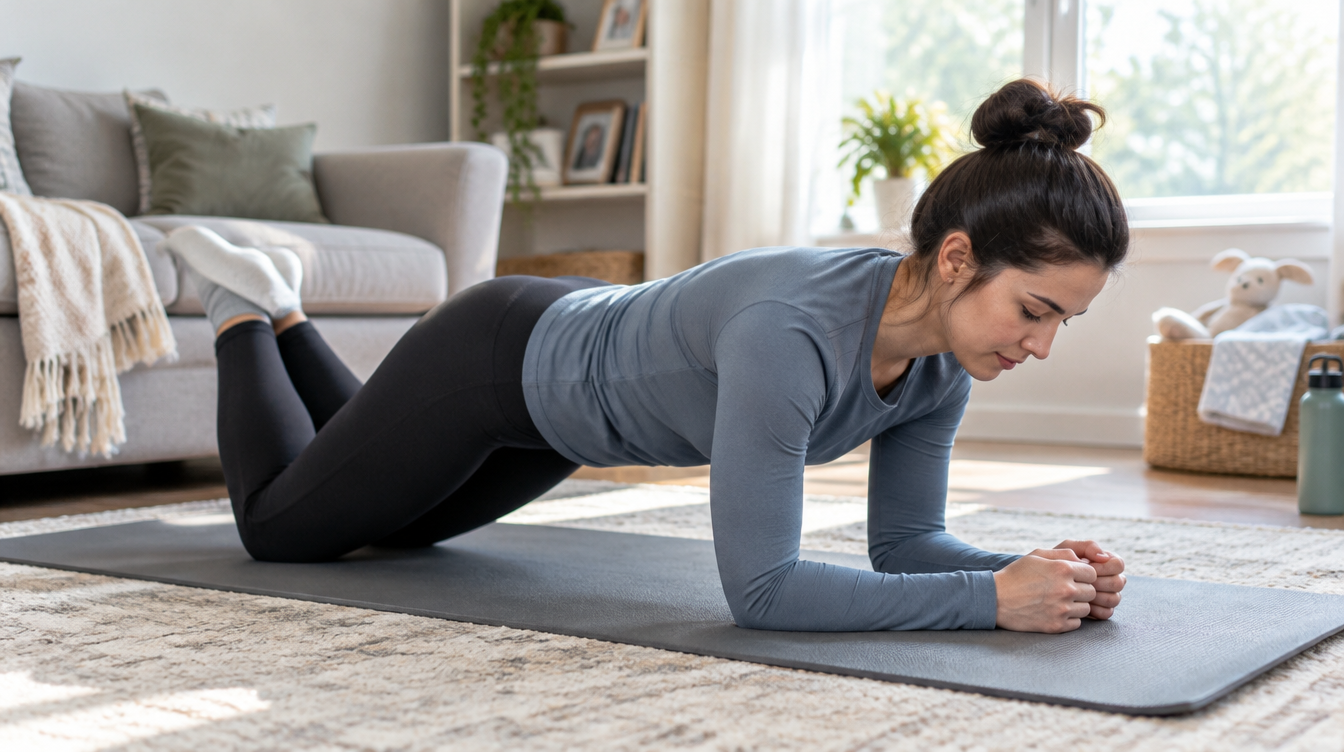
- Knee plank — traditional forearm or hand position, knees down instead of toes. A meaningful jump up in difficulty from incline.
- Full plank — only once knee plank is genuinely doming-free and feels stable, not just "doable."
Move up this list only when the level below it is boring, not when it's merely possible. A plank you can grit your way through while doming is not a step forward.
What this looks like in practice
Mum21's own progression follows exactly this logic rather than a week-by-week script: alignment and breathing come first, pressure management comes before any plank variation at all, and the plank progression above only starts once that foundation is doming-free in easier positions. It's slower in week one. It's the version still making progress in week eight.
FAQs
Because this guide mentions…
- Belly Doming ExplainedWhat doming signals about pressure management, and how to stop it.
- Diastasis Recti GuideAssess the gap, understand what closes it, and progress safely.
- Lateral Breathing BasicsThe breathing mechanic every deep-core exercise is built on.
- Pelvic Floor GuideWhy leaks and heaviness happen, and how to train the floor properly.
Clinical references
- Gluppe et al., Fisioter Pesqui 2021PMID 34391661
- Sperstad et al., Br J Sports Med 2016PMID 27324871
Mum21 guides cite peer-reviewed research and professional physiotherapy guidance. They are educational and do not replace individual medical care.
Written by
Ana (Anastasia Uvarova)
Women's Health Physiotherapist
UK-qualified physiotherapist, founder of Alpha Physio Care
UK-qualified women's health physiotherapist and founder of Alpha Physio Care. Ana designed the Mum21 12-week recovery program.
Medically reviewed by
Mum21 Clinical Team
Editorial and clinical review
Physiotherapy-led editorial team
The Mum21 editorial team works with practising women's health physiotherapists to keep every guide accurate and current.
Last clinical review: 7 September 2026
Part of the Core Recovery topic hub, a physiotherapist-reviewed collection of guides on core recovery.
Join 10,000+ Mums
Honest, physio-backed postpartum recovery tips in your inbox. One email a week. No spam, ever.
No spam. Unsubscribe in one click.
Continue reading
The next steps in the core recovery learning path.
- Returning to Weightlifting or CrossFit With Diastasis RectiHeavy lifting asks something specific of your core that a plank doesn't — a hard breath-hold under real load. Here's how to get back to real weight safely, not just 'light weights forever.' 7 min read · Core Recovery
- Running After Diastasis Recti: When and How to Safely ReturnRunning is high-impact in a way planks aren't — it's not just about your gap, it's about your whole pelvic floor and load tolerance. Here's the actual criteria-based approach, not a fixed week number. 8 min read · Core Recovery
- Rib Flare and Diastasis Recti: Why Posture Comes Before Any ExerciseIf your ribs sit flared out in front of your pelvis, no amount of core exercise will fully catch up — the alignment itself is working against you. Here's the mechanism, and how to check your own. 6 min read · Core Recovery
Related topics
Diastasis Recti
Everything on diastasis recti in one place: how to check your gap at home, what closes it, what makes it worse and how long real recovery actually takes.
18 guidesC-Section Recovery
Physio-led guidance on cesarean healing: scar mobility, the C-section shelf, safe timelines and exactly when to restart core work after your surgery.
11 guidesPelvic Floor
Leaks, heaviness, pressure management and pelvic floor training after birth, explained step by step by a UK-qualified women's health physiotherapist.
4 guides