Deep Core Activation, The Foundation Exercise
In this article
Your deep core is a canister: diaphragm on top, pelvic floor at the bottom, transversus abdominis wrapping around like a corset. If it doesn't work together, your outer abs (rectus, obliques) fire in isolation and the linea alba never gets the support it needs.
Here's how to switch it back on.
The exercise
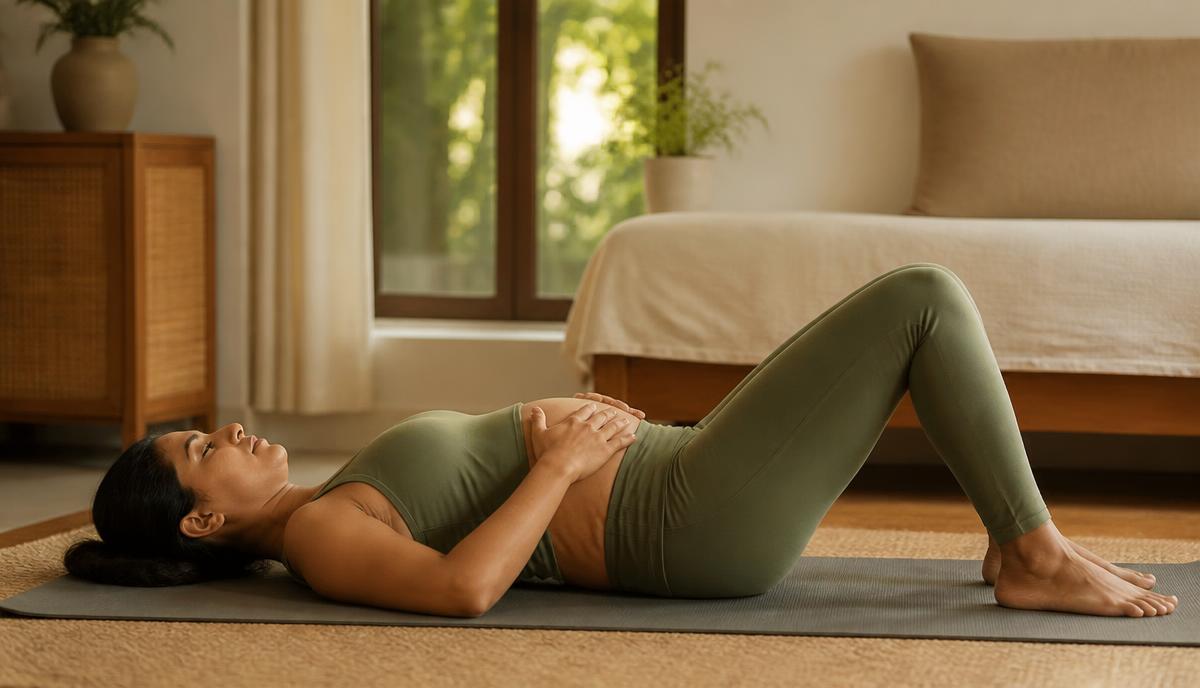
Set-up
- Lie on your back
- Knees bent, feet flat, hip-width apart
- Head on a pillow, spine in neutral (a small natural arch under the lower back is fine)
- One hand on your lower belly, one on your ribs
The 4-step activation
- Inhale slowly through the nose. Feel the ribs widen sideways into the mat. The belly stays soft.
- Exhale through pursed lips, long and slow, over 6 seconds.
- As you exhale, imagine drawing a blueberry up from your vaginal opening toward your navel. Simultaneously, feel the lower belly gently flatten toward the spine.
- Fully release on the next inhale. Nothing held.
Do 10 breaths. Rest. Repeat 2 more sets. Total: 5 minutes.
What "right" feels like
- A gentle, subtle tightening across the lower belly
- The pelvic floor lifting a millimetre or two
- No visible ridge (dome) down the middle of the belly
- No held breath
- No clenched jaw or shoulders
The three most common mistakes
1. Sucking in the belly hard. You're recruiting the wrong muscles (rectus abdominis) and pushing pressure downward on the pelvic floor. Should feel like 20% effort, not 80%.
2. Holding the breath. The whole point is the breath. If you're holding, you're bracing, not activating.
3. Tilting the pelvis. The pelvis should not tuck under. Spine stays neutral.
Progressions (weeks 1 to 8)
- Weeks 1 to 2: 3 sets of 10 breaths, lying down only
- Weeks 3 to 4: Add sitting on a chair, then standing
- Weeks 5 to 6: Combine with heel slides, lying down
- Weeks 7 to 8: Add during daily movement, exhale-activate before lifting baby, before standing up, before every bend
Why this matters more than crunches
Crunches train the rectus abdominis in isolation. They add nothing to the deep core canister. If your rectus is separated (diastasis), crunches can widen the gap. Deep core activation rebuilds the tissue you actually stretched.
Twelve minutes a day of this exercise, done consistently for 6 weeks, closes more diastasis gap than any other single intervention in the physio literature.
FAQs
Because this guide mentions…
- Pelvic Floor GuideWhy leaks and heaviness happen, and how to train the floor properly.
- Why the Mum Pooch StaysThe difference between fat, bloat and true abdominal separation.
- Lateral Breathing BasicsThe breathing mechanic every deep-core exercise is built on.
- C-Section RecoveryScar mobility, the C-section shelf and a safe return to core work.
Written by
Ana (Anastasia Uvarova)
Women's Health Physiotherapist
UK-qualified physiotherapist, founder of Alpha Physio Care
UK-qualified women's health physiotherapist and founder of Alpha Physio Care. Ana designed the Mum21 12-week recovery program.
Medically reviewed by
Ana (Anastasia Uvarova)
Women's Health Physiotherapist
UK-qualified physiotherapist, founder of Alpha Physio Care
UK-qualified women's health physiotherapist and founder of Alpha Physio Care. Ana designed the Mum21 12-week recovery program.
Last clinical review: 26 June 2026
Part of the Core Recovery topic hub, a physiotherapist-reviewed collection of guides on core recovery.
Join 10,000+ Mums
Honest, physio-backed postpartum recovery tips in your inbox. One email a week. No spam, ever.
No spam. Unsubscribe in one click.
Continue reading
The next steps in the core recovery learning path.
- Returning to Weightlifting or CrossFit With Diastasis RectiHeavy lifting asks something specific of your core that a plank doesn't — a hard breath-hold under real load. Here's how to get back to real weight safely, not just 'light weights forever.' 7 min read · Core Recovery
- Running After Diastasis Recti: When and How to Safely ReturnRunning is high-impact in a way planks aren't — it's not just about your gap, it's about your whole pelvic floor and load tolerance. Here's the actual criteria-based approach, not a fixed week number. 8 min read · Core Recovery
- Rib Flare and Diastasis Recti: Why Posture Comes Before Any ExerciseIf your ribs sit flared out in front of your pelvis, no amount of core exercise will fully catch up — the alignment itself is working against you. Here's the mechanism, and how to check your own. 6 min read · Core Recovery
Related topics
Diastasis Recti
Everything on diastasis recti in one place: how to check your gap at home, what closes it, what makes it worse and how long real recovery actually takes.
18 guidesC-Section Recovery
Physio-led guidance on cesarean healing: scar mobility, the C-section shelf, safe timelines and exactly when to restart core work after your surgery.
11 guidesPelvic Floor
Leaks, heaviness, pressure management and pelvic floor training after birth, explained step by step by a UK-qualified women's health physiotherapist.
4 guides