Bird-Dog, The Best Core Exercise Nobody Talks About
In this article
Bird-dog trains your core to resist rotation and extension while your limbs move. That's exactly what your core has to do when you're feeding, carrying a car seat, or lifting a toddler out of a cot.
The exercise
Set-up
- Hands and knees on the mat
- Hands directly under shoulders, knees directly under hips
- Spine long, gaze slightly forward
- Ribs gently drawn together (don't let the belly sag)
The movement
- Inhale to the sides of the ribs
- Exhale slowly, feel the lower belly gently draw up
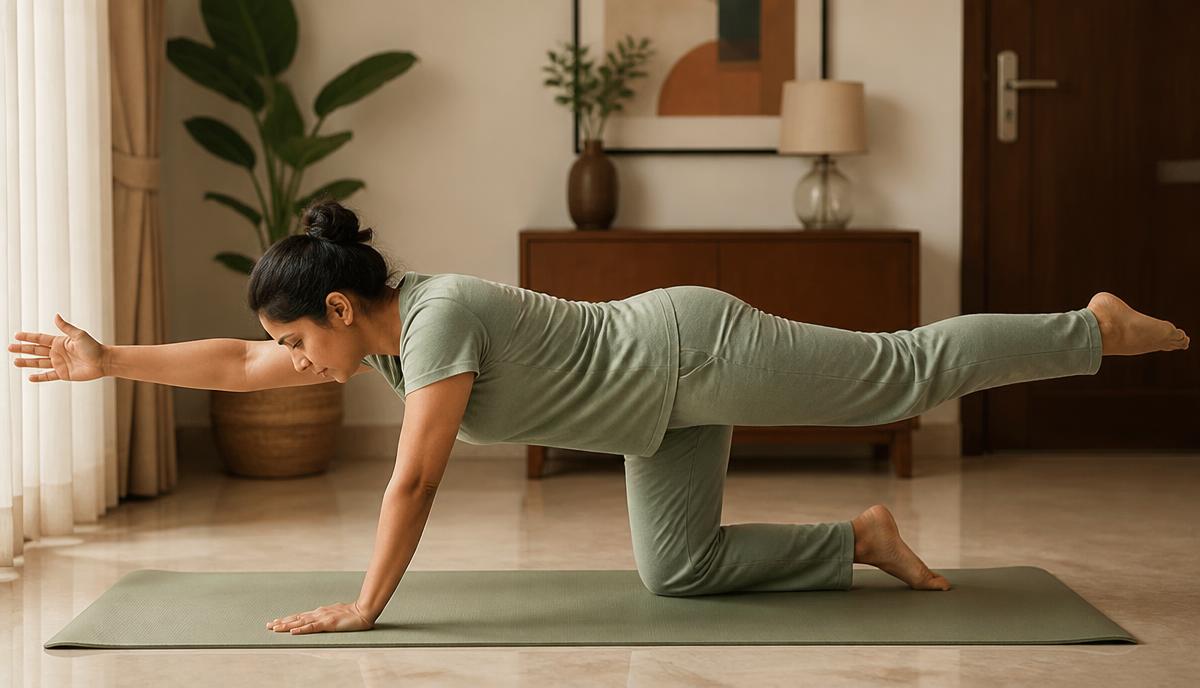
- Extend your right arm forward and your left leg back, until both are parallel to the floor
- Hold 3 seconds, breathing normally
- Return with control on an inhale
- Alternate sides
Do 8 to 10 each side, 2 sets. Daily.
What "right" looks like
- The pelvis stays perfectly level, no rotation
- No arching of the lower back
- The extended arm and leg form a straight line with the spine
- Slow, controlled movement, no wobbling
The two most common mistakes
Mistake 1: extending too high. The arm and leg go above the line of the spine, which arches the lower back. Fix: lower the arm and leg to spine-height only.
Mistake 2: rotating the hips. As one leg lifts, the same hip rises. Fix: place a small object (a coin, a folded towel) on your lower back. If it falls off, you rotated.
Regressions if it feels too hard
- Arm only: lift only the arm, keep both knees down. Then progress.
- Leg only: lift only the leg, keep both hands down.
- Toe-tap: slide the toe back along the floor without lifting.
Progressions once it feels easy
- Slow tempo: 4 seconds out, 4 seconds hold, 4 seconds back
- Add elbow-to-knee: at the return, bring the elbow and knee toward each other under the body
- Bird-dog with a resistance band looped around the extending foot and the extending hand
Why it works
Bird-dog trains anti-rotation and anti-extension, the two things a postpartum core is worst at. It also strengthens the multifidus (deep spinal muscles) that stabilise your lower back, without loading the linea alba.
Do it daily, and within 3 weeks you'll notice you can lift, carry and reach with less back pain and less belly doming.
FAQs
Because this guide mentions…
- Lower Back Pain After BabyWhy a weak deep core shows up as back pain, and what helps.
- Belly Doming ExplainedWhat doming signals about pressure management, and how to stop it.
- C-Section RecoveryScar mobility, the C-section shelf and a safe return to core work.
- Diastasis Recti GuideAssess the gap, understand what closes it, and progress safely.
Written by
Ana (Anastasia Uvarova)
Women's Health Physiotherapist
UK-qualified physiotherapist, founder of Alpha Physio Care
UK-qualified women's health physiotherapist and founder of Alpha Physio Care. Ana designed the Mum21 12-week recovery program.
Medically reviewed by
Ana (Anastasia Uvarova)
Women's Health Physiotherapist
UK-qualified physiotherapist, founder of Alpha Physio Care
UK-qualified women's health physiotherapist and founder of Alpha Physio Care. Ana designed the Mum21 12-week recovery program.
Last clinical review: 4 July 2026
Part of the Core Recovery topic hub, a physiotherapist-reviewed collection of guides on core recovery.
Join 10,000+ Mums
Honest, physio-backed postpartum recovery tips in your inbox. One email a week. No spam, ever.
No spam. Unsubscribe in one click.
Continue reading
The next steps in the core recovery learning path.
- Returning to Weightlifting or CrossFit With Diastasis RectiHeavy lifting asks something specific of your core that a plank doesn't — a hard breath-hold under real load. Here's how to get back to real weight safely, not just 'light weights forever.' 7 min read · Core Recovery
- Running After Diastasis Recti: When and How to Safely ReturnRunning is high-impact in a way planks aren't — it's not just about your gap, it's about your whole pelvic floor and load tolerance. Here's the actual criteria-based approach, not a fixed week number. 8 min read · Core Recovery
- Rib Flare and Diastasis Recti: Why Posture Comes Before Any ExerciseIf your ribs sit flared out in front of your pelvis, no amount of core exercise will fully catch up — the alignment itself is working against you. Here's the mechanism, and how to check your own. 6 min read · Core Recovery
Related topics
Diastasis Recti
Everything on diastasis recti in one place: how to check your gap at home, what closes it, what makes it worse and how long real recovery actually takes.
18 guidesC-Section Recovery
Physio-led guidance on cesarean healing: scar mobility, the C-section shelf, safe timelines and exactly when to restart core work after your surgery.
11 guidesPelvic Floor
Leaks, heaviness, pressure management and pelvic floor training after birth, explained step by step by a UK-qualified women's health physiotherapist.
4 guides