Wall Sits and Squats After Birth, When and How to Return
In this article
- The postpartum squat progression
- Weeks 1 to 3: sit-to-stand
- Weeks 4 to 6: wall sit
- Weeks 6 to 8: bodyweight box squat
- Weeks 8+: full bodyweight squat
- The pelvic floor cue
- The three most common form problems
- Red flags, stop and see a physio
- Why squats matter more than crunches
- FAQs
- When can I squat after a C-section?
- Are squats safe with diastasis recti?
- How deep should I squat?
Every time you pick up your baby off the floor, put them in a cot, or sit down on a low chair, you're squatting. Weak squats become chronic knee pain, back pain and pelvic floor overload. Here's how to rebuild them safely.
The postpartum squat progression
Weeks 1 to 3: sit-to-stand
- From a firm chair, feet flat, hip-width apart
- Exhale, lean forward from the hips, drive through the heels
- Stand up without using your hands
- Sit back down with control
- 10 reps, 2 sets, daily
If sit-to-stand causes leaking, heaviness or pain, stop and see a pelvic floor physio before progressing.
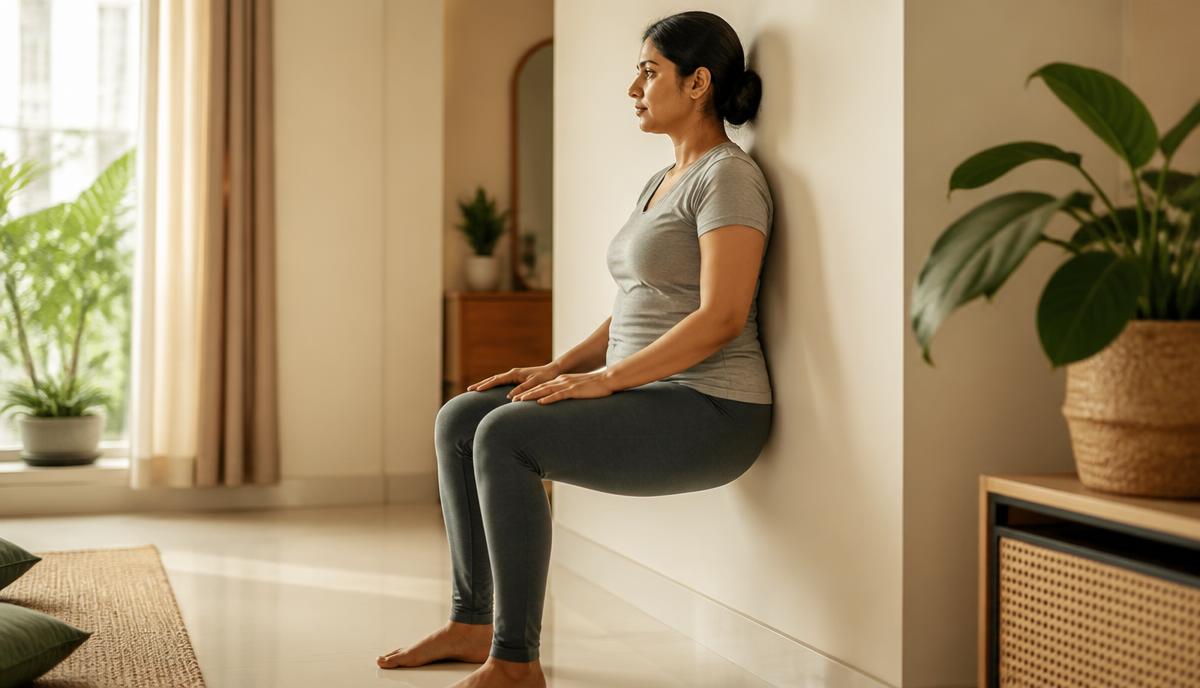
Weeks 4 to 6: wall sit
- Back against a wall, feet 30 cm out and hip-width apart
- Slide down until knees are at a comfortable angle (start at 45 degrees, not 90)
- Hold 15 seconds, build to 30 seconds
- 3 rounds, daily
- Focus on breath, don't hold it
Weeks 6 to 8: bodyweight box squat
- Stand in front of a low chair or bench
- Feet hip-width, toes pointing slightly out
- Inhale as you lower back and down, tapping the chair with your glutes
- Exhale as you drive up through the heels
- 10 to 12 reps, 2 to 3 sets
Weeks 8+: full bodyweight squat
- Same setup, no chair
- Squat to depth where your form stays clean (thigh parallel to floor is the goal, not the starting point)
- Progress to holding weight (start with 2 to 4 kg) once bodyweight squats feel controlled
The pelvic floor cue
Every squat, without exception:
- Inhale on the way down. Pelvic floor lengthens.
- Exhale on the way up. Pelvic floor lifts. Deep core zips in.
If you flip the breath (exhale down, inhale up), you're pushing pressure straight into a healing pelvic floor. Common mistake, easy to fix.
The three most common form problems
1. Knees cave in. Weak glutes. Cue "spread the floor apart with your feet" or loop a resistance band above the knees.
2. Heels lift off the floor. Tight calves or ankles. Work on ankle mobility, or squat with a folded mat under the heels while you improve mobility.
3. Chest collapses forward. Weak upper back. Hold a light dumbbell at chest height in front of you (goblet squat position) to reset posture.
Red flags, stop and see a physio
- Leaking urine on any squat variation
- Heaviness or a bulging sensation in the vagina during or after
- Sharp pain in the front of the pubic bone (pelvic girdle pain)
- Knee pain that lingers after the session
Why squats matter more than crunches
Squats train your core in the position you actually use it, upright, moving, loaded. They also load bone (protecting against postpartum bone density loss from breastfeeding), fire the glutes, and rehearse the pelvic floor coordination you need for the rest of your life.
FAQs
Because this guide mentions…
- Pelvic Floor GuideWhy leaks and heaviness happen, and how to train the floor properly.
- Lower Back Pain After BabyWhy a weak deep core shows up as back pain, and what helps.
- C-Section RecoveryScar mobility, the C-section shelf and a safe return to core work.
- Diastasis Recti GuideAssess the gap, understand what closes it, and progress safely.
Written by
Ana (Anastasia Uvarova)
Women's Health Physiotherapist
UK-qualified physiotherapist, founder of Alpha Physio Care
UK-qualified women's health physiotherapist and founder of Alpha Physio Care. Ana designed the Mum21 12-week recovery program.
Medically reviewed by
Ana (Anastasia Uvarova)
Women's Health Physiotherapist
UK-qualified physiotherapist, founder of Alpha Physio Care
UK-qualified women's health physiotherapist and founder of Alpha Physio Care. Ana designed the Mum21 12-week recovery program.
Last clinical review: 8 July 2026
Part of the Core Recovery topic hub, a physiotherapist-reviewed collection of guides on core recovery.
Join 10,000+ Mums
Honest, physio-backed postpartum recovery tips in your inbox. One email a week. No spam, ever.
No spam. Unsubscribe in one click.
Continue reading
The next steps in the core recovery learning path.
- Returning to Weightlifting or CrossFit With Diastasis RectiHeavy lifting asks something specific of your core that a plank doesn't — a hard breath-hold under real load. Here's how to get back to real weight safely, not just 'light weights forever.' 7 min read · Core Recovery
- Running After Diastasis Recti: When and How to Safely ReturnRunning is high-impact in a way planks aren't — it's not just about your gap, it's about your whole pelvic floor and load tolerance. Here's the actual criteria-based approach, not a fixed week number. 8 min read · Core Recovery
- Rib Flare and Diastasis Recti: Why Posture Comes Before Any ExerciseIf your ribs sit flared out in front of your pelvis, no amount of core exercise will fully catch up — the alignment itself is working against you. Here's the mechanism, and how to check your own. 6 min read · Core Recovery
Related topics
Diastasis Recti
Everything on diastasis recti in one place: how to check your gap at home, what closes it, what makes it worse and how long real recovery actually takes.
18 guidesC-Section Recovery
Physio-led guidance on cesarean healing: scar mobility, the C-section shelf, safe timelines and exactly when to restart core work after your surgery.
11 guidesPelvic Floor
Leaks, heaviness, pressure management and pelvic floor training after birth, explained step by step by a UK-qualified women's health physiotherapist.
4 guides