Postpartum Hip and Pelvic Mobility, The Missing Piece
In this article
- Why mobility matters as much as strength
- The 10-minute daily routine
- 1. Cat-cow with breath (2 minutes)
- 2. Deep supported squat (2 minutes)
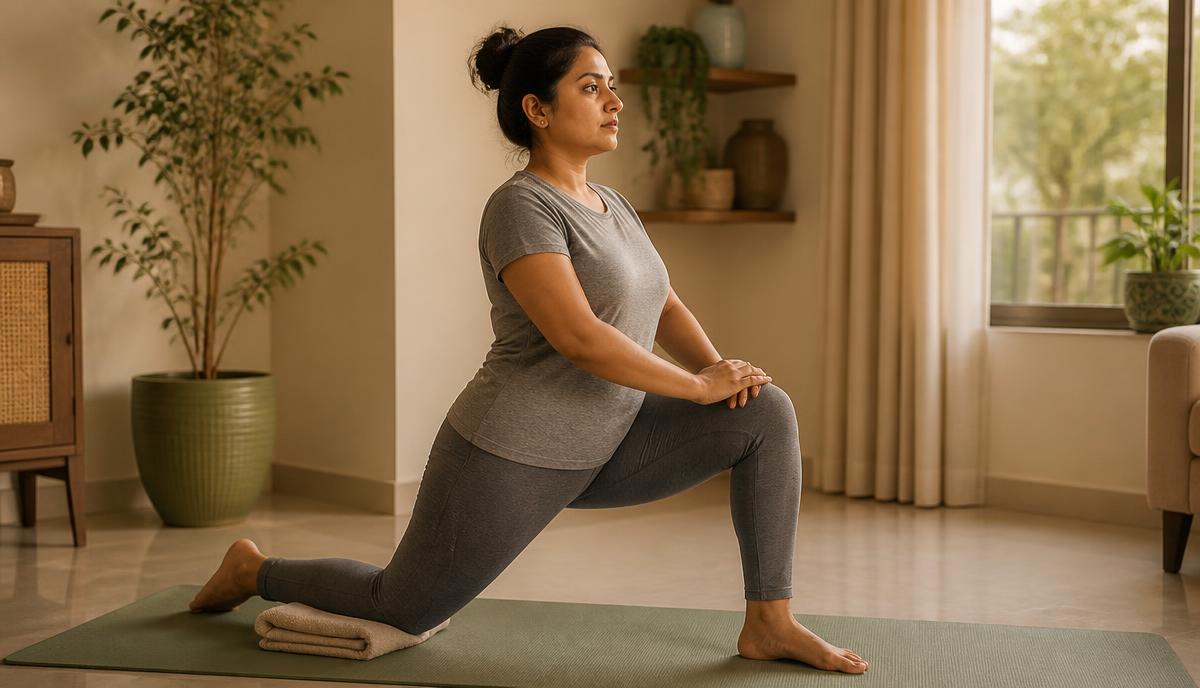
- 3. Hip flexor stretch, kneeling (1 min each side)
- 4. Figure-4 stretch, lying (1 min each side)
- 5. Thoracic rotation, lying (1 min)
- 6. Child's pose with side reach (1 min)
- When to do it
- What you'll notice
- Skip these "mobility" moves postpartum
- FAQs
- Is yoga safe postpartum?
- How is mobility different from stretching?
- Can I do this if I had a C-section?
Nine months of a growing bump shifts your pelvis forward, tightens your hip flexors, and locks up the muscles around the sacrum. Strength work alone doesn't unpick that. You need mobility.
Why mobility matters as much as strength
A stiff pelvis:
- Can't fully lengthen the pelvic floor on the inhale (which means kegels lift into tension, not from length)
- Overloads the lower back on every step
- Prevents the glutes from firing at their strongest angle
- Makes squats and lunges feel harder than they should
Mobility restores range, which lets strength do its job.
The 10-minute daily routine
1. Cat-cow with breath (2 minutes)
Hands and knees. Inhale, drop the belly, look forward (cow). Exhale, round the back, tuck the chin (cat). Slow. 10 rounds.
2. Deep supported squat (2 minutes)
Squat as low as comfortable, holding onto a chair or door frame for support. Let the tailbone drop. Breathe into the sides of the ribs. Hold up to 2 minutes.
3. Hip flexor stretch, kneeling (1 min each side)
Kneel on the mat, one foot forward. Tuck the tailbone under, squeeze the glute of the back leg. Hold 60 seconds. Switch sides.
4. Figure-4 stretch, lying (1 min each side)
Lie on your back, cross the right ankle over the left thigh. Pull the left thigh toward you. Hold 60 seconds. Switch sides.
5. Thoracic rotation, lying (1 min)
Lie on your side, knees stacked at 90 degrees. Reach the top arm across the body to the other side, following it with your eyes. Hold 3 breaths. 5 rounds each side.
6. Child's pose with side reach (1 min)
Sit back onto your heels, walk hands forward. Then walk hands to the right, hold 30 seconds. Repeat left.
When to do it
Best times, in order of impact:
- Right before your daily core routine (opens tissue so activation lands better)
- First thing in the morning (undoes overnight stiffness)
- Before bed (calms the nervous system, improves sleep)
What you'll notice
- Week 1: less stiffness getting out of bed
- Week 2: easier to squat down for baby, less "cracking" in the pelvis
- Week 3: fewer leaks (pelvic floor can now lengthen properly)
- Week 4: less lower back pain by afternoon
Skip these "mobility" moves postpartum
- Deep pigeon pose on the floor (compresses the pubic joint)
- Full lotus (loads the SI joint too aggressively)
- Standing forward fold to touch the floor (stretches connective tissue that's already loose)
- Aggressive backbends (bridge, wheel, camel) until at least 12 weeks postpartum
FAQs
Because this guide mentions…
Written by
Ana (Anastasia Uvarova)
Women's Health Physiotherapist
UK-qualified physiotherapist, founder of Alpha Physio Care
UK-qualified women's health physiotherapist and founder of Alpha Physio Care. Ana designed the Mum21 12-week recovery program.
Medically reviewed by
Ana (Anastasia Uvarova)
Women's Health Physiotherapist
UK-qualified physiotherapist, founder of Alpha Physio Care
UK-qualified women's health physiotherapist and founder of Alpha Physio Care. Ana designed the Mum21 12-week recovery program.
Last clinical review: 12 July 2026
Part of the Core Recovery topic hub, a physiotherapist-reviewed collection of guides on core recovery.
Join 10,000+ Mums
Honest, physio-backed postpartum recovery tips in your inbox. One email a week. No spam, ever.
No spam. Unsubscribe in one click.
Continue reading
The next steps in the core recovery learning path.
- Returning to Weightlifting or CrossFit With Diastasis RectiHeavy lifting asks something specific of your core that a plank doesn't — a hard breath-hold under real load. Here's how to get back to real weight safely, not just 'light weights forever.' 7 min read · Core Recovery
- Running After Diastasis Recti: When and How to Safely ReturnRunning is high-impact in a way planks aren't — it's not just about your gap, it's about your whole pelvic floor and load tolerance. Here's the actual criteria-based approach, not a fixed week number. 8 min read · Core Recovery
- Rib Flare and Diastasis Recti: Why Posture Comes Before Any ExerciseIf your ribs sit flared out in front of your pelvis, no amount of core exercise will fully catch up — the alignment itself is working against you. Here's the mechanism, and how to check your own. 6 min read · Core Recovery
Related topics
Diastasis Recti
Everything on diastasis recti in one place: how to check your gap at home, what closes it, what makes it worse and how long real recovery actually takes.
18 guidesC-Section Recovery
Physio-led guidance on cesarean healing: scar mobility, the C-section shelf, safe timelines and exactly when to restart core work after your surgery.
11 guidesPelvic Floor
Leaks, heaviness, pressure management and pelvic floor training after birth, explained step by step by a UK-qualified women's health physiotherapist.
4 guides